Our Mission
A vision for regenerative landscapes and pollinator corridors that reconnect people—one small space at a time.
Our Mission
A vision for regenerative landscapes and pollinator corridors that reconnect people—one small space at a time.
A vision for regenerative landscapes and pollinator corridors that reconnect people—one small space at a time.
A vision for regenerative landscapes and pollinator corridors that reconnect people—one small space at a time.
I am Anne Pounds. Not long ago I wrote and published a novel I named Call Me Eve. It began unfolding with just a little input from me—kind of took off on its own, seemingly sure of where it wanted to go.
I can’t say it didn’t surprise me who Eve became; and it also delighted me. Besides its being a pretty good murder mystery with a touch of offbeat romance, my protagonist Eve becomes a passionate sustainable landscape designer who catches the essence of what she calls “climate crisis,” as she materially transforms the landscape around her with her team of skilled builders and planters she recruits from the nearby immigrant community.
They begin building rain gardens, bogs, rooftop gardens, and raised-bed organic gardens for wealthy landowners. Though her hubris about her sense of sureness trips her up initially, her passion becomes building habitats for birds and insects.
Another surprise: It’s been weighing on me that it’s not quite enough to write a good story (it is one, I promise you. Enjoy the story.) and just leave the ideas spun together in fiction—that it’s better to find some ways to take action.
But I’ve been gardening for over fifty years, and I had considered my garden “built.” My aching back thought I was mostly done.
I became a birder decades ago after reading a story about Roger Tory Peterson, the beloved author of Birds of North America. He described a four-day birding trip to a remote cabin in a well-known birding area. It rained the entire time. While the others trudged out into the downpour, Peterson stayed mostly on the covered porch, sitting in an Adirondack chair, identifying birds by ear.
At the end of the weekend, he had identified more birds than anyone else.
That story stayed with me.
I began birding that way—listening first, then following the sound until I found the bird. For years, wherever we went, I would wander off in pursuit of birdsong while my husband, Bob, happily stayed behind reading.
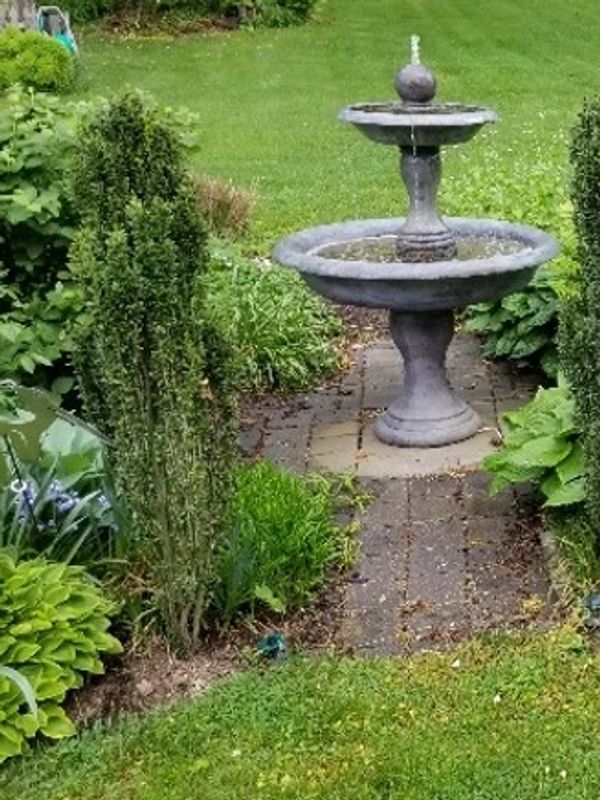
Over time, we began shaping our property into a place that birds would love. We built places for them to drink and bathe, and planted trees and shrubs to feed and shelter them. Much of what exists here today—raised beds, pathways, irrigation systems, fountains—was built gradually, with care and persistence.
And then something shifted.
Birds led us to the larger web of life. Without setting out to, our gardens filled with insects and butterflies, and we began to understand their roles. I learned that tent caterpillars are essential bird food (I’ve tried to hate them less), that the striking caterpillars on fennel and dill become swallowtail butterflies, and that even spiders have their place.
Only recently have I begun to understand the importance of native pollinators—like mason bees, which emerge early in spring and are critical to pollinating fruit trees before honeybees are even active.
I belong to a wonderful little local group called “Buy Nothing,” and every Spring I began sharing plants that I had an abundance of. I kept meeting brilliant native plant enthusiasts who know much more than I do, and each friendship has brought me closer to wanting to be one of them. Slowly, with their help, I am adding pollinators. Against my slight resistance, my desire to do all I can to carry out Eve’s vision and become a missionary for what I called “pollinator strips” in the book seems more necessary every day.

In the series Clarkson’s Farm, set in the Cotswolds of England, hedgerows are not optional—they are required—supporting wildlife and helping prevent erosion.
That idea stayed with me.
At first, I wondered whether anything similar could take hold here. Converting American landscapes to hedgerows seemed like a bridge too far. But then I began to look more closely at what surrounds us every day:
Expanses of turf grass in business parks, industrial parks, and shopping centers—carefully maintained, chemically treated, and increasingly lifeless.
Mulched beds planted with seasonal color—designed to look beautiful for a moment, then removed and replaced again and again.
We have learned to see this as “landscaping.”
But what if we saw landscapes differently?
What if, instead of landscaping for appearance, we landscaped for life?
Imagine edging these spaces with native pollinator strips—living borders that return value to the land and support the small creatures on which our lives depend: bees, butterflies, birds, and even ants.
This is not just an aesthetic shift. It is a paradigm change.
What A Shift Like This Could Become
Over time, these landscapes would require a different kind of care—not constant replacement, but ongoing nurturing.
And perhaps most importantly, they would invite people to become more curious, more engaged, and more connected to the land they steward (and maybe once again, to each other).
Imagine This…
A simple sign at the entrance to an office park:
“This Living Landscape Supports
120 Species of Native Pollinators:
Reduced mowing • Reduced chemical inputs
Increased biodiversity"
Not just a landscape—but an identity.
This is where Pollinator Buzz begins.